


How we got here - rick's story


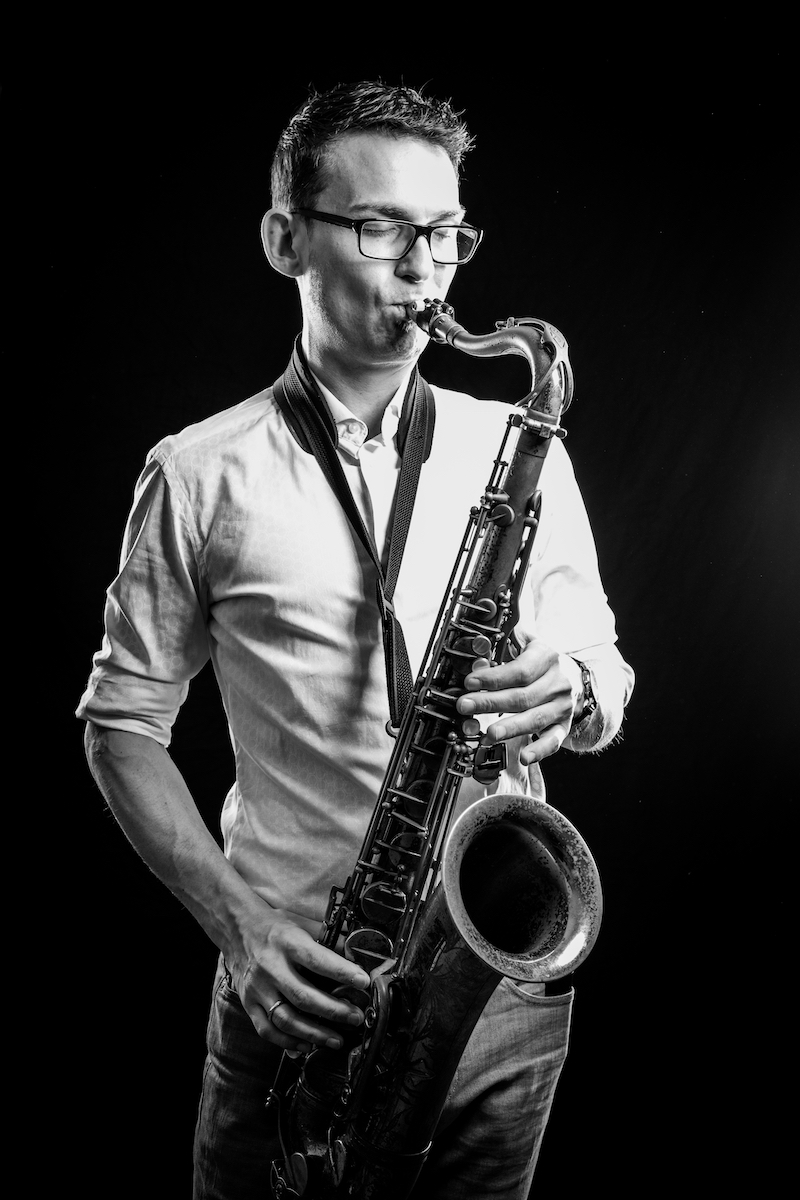 In 2020, while the shops reluctantly closed their doors and the automobiles became a comfortable place for spiders to spin their webs, I often found myself retreating to the refuge of my rehearsal room, haunted by a small collection of musical instruments and a paranoid uncertainty about where my life was headed.
You know how folks say, "What would you do with your time if you didn't have ever have to go to work again?" That opportunity presented itself to me like a splash of cold water when COVID emptied my calendar. You see, for the ten years prior to lock-down I had been making a good living as an entertaining pianist and guitarist, somewhat-crooning songs to people that people could sing-along to. And when the steady income that job provided was no longer an thing, I found myself answering to my first for of musical expression, the saxophone.
I found myself become a complusive woodwind practicer for the first time since I left the USA for Germany in 2012. I forced myself daily to get out of bed, bicycle the empty streets to my rehearsal room and play 30 minutes of flute, my least-developed woodwind instrument. Only after I put some time in on that little silver taskmaster would I allow myself to be immersed again by the music I first came to love: saxophone jazz & improvisation.
Coincidentally, in December of 2020 I saw a posting on a German saxophone forum website that said that the WDR Big Band was holding auditions for tenor saxophone. I needed to submit a resume and also recordings of myself playing sax, flute and clarinet. I assume most of you well-cultured people already know who the WDR Big Band is, but in case you don't, you absolutely should. They are one of the top big bands in the world and anybody-who-is-anybody in jazz has used them as a backing band. The entire band is screaming with top-tier talent. Needless to say, this would be a dream gig for any working sax player, myself (and about 999 world-class players) included.
hi-ho, hi-ho, it's off to work we go..
The audition material needed to be submitted by the end of January, 2021. Starting late, I had only about 5 weeks to get my package together. I had already been hitting the flute and tenor saxophone hard for a year (thankfully), however I had left my clarinet collecting dust for almost ten years. After many hours of panic-shedding, I threw together audition videos of my flute and clarinet playing, hoping the band will see my potential and whisk me away to the promised land (where I can learn these instruments for real). For my saxophone material, I decided last-minute to do something a little more challenging. I would self-arrange a tenor feature backed up by myself on soprano/alto/tenor/baritone saxes. I'd always loved arranging and I work best with a deadline so I immediately began preparing for the work ahead.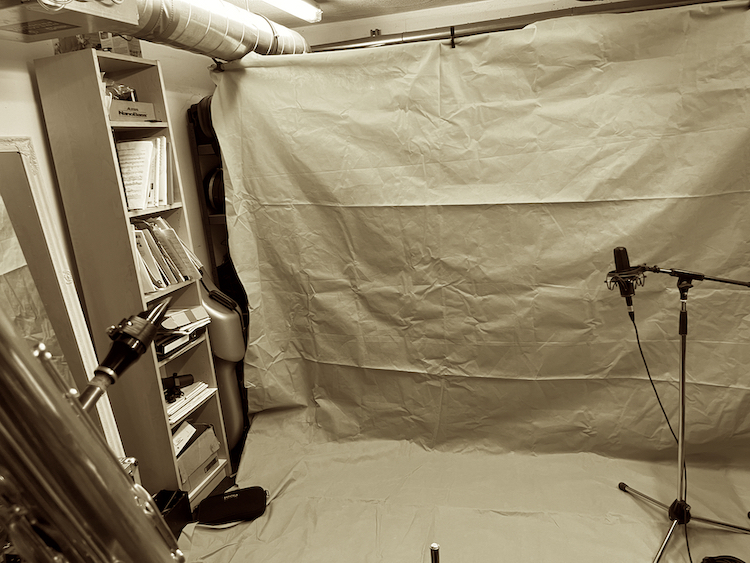 It took me awhile to get back into the arrangers mindset, plus I decided to learn a new modern computer music notation program at the same time. But after many sleepless nights watching YouTube videos, experimenting with concepts and finally writing, I had a finished saxophone quartet + 1 arrangement. And I thought it would sound pretty good.
Next was converting my rehearsal room into a place where I could record the live audio and film the live video. Most of the "section" parts I was able to knock out in one or two takes, however the solo tenor saxophone part took somewhere like 96 takes before I was finally happy with the way the improvisation weaved in and out of the section parts. Mental toughness, I bet the WDR Big Band likes that..!
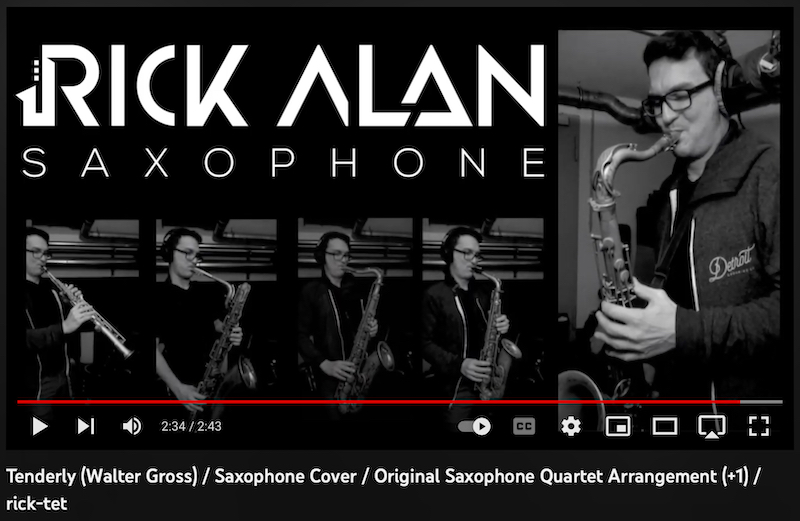
Now that I had everything satisfactorily recorded I realized that I hadn't edited any video in about 20 years. It took plenty of coffee and late-night hours to figure out how to download the raw video into Final Cut, chop it up, line up the video and audio, edit it and make it somewhat entertaining. And all I was doing was making five little grey boxes appear on the screen with myself and a saxophone inside each box, all performing each of the self-written quintet parts live that I scored for the jazz standard "Tenderly". After all the blood, sweat and tears I was actually quite impressed with myself for a handful of minutes.
A long month later the email from the WDR Big Band arrived informing me that I would not be invited to play in the elimination round. I was honestly not surprised. I'm sure 1000 recently-unemployed better-than-me saxophonists from around the globe auditioned for this prestigious gig also received the same email that I did, but I can't say I wasn't a little disappointed.
sharing the experience
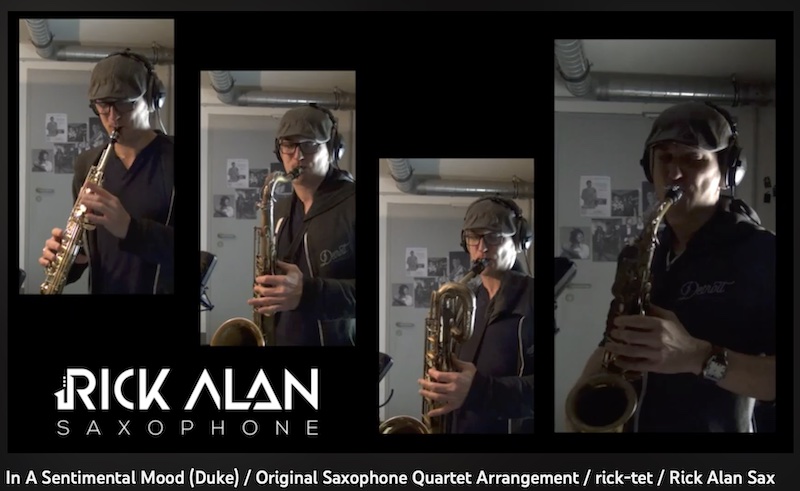
I received such a positive response for my arrangement of "Tenderly" that I decided try my hand at another one of my favorite jazz standards, "In A Sentimental Mood." I penned it as an alto feature despite the fact I've never considered myself a true alto player but hey, no audition on the line this time! I also dropped the five-voice "featured artist" writing and went to standard saxophone quartet writing. The tune was more of a challenge than "Tenderly" because A) the tune is a ballad and B) attempting to keep a full, interesting sound with four voices is more difficult than with five voices. On a plus note, the notation software became easier to use and the video editing process didn't take nearly as long. I uploaded my second video to the YouTube channel and, once again, the critics seemed to appreciate my effort. So I did another one. And another.
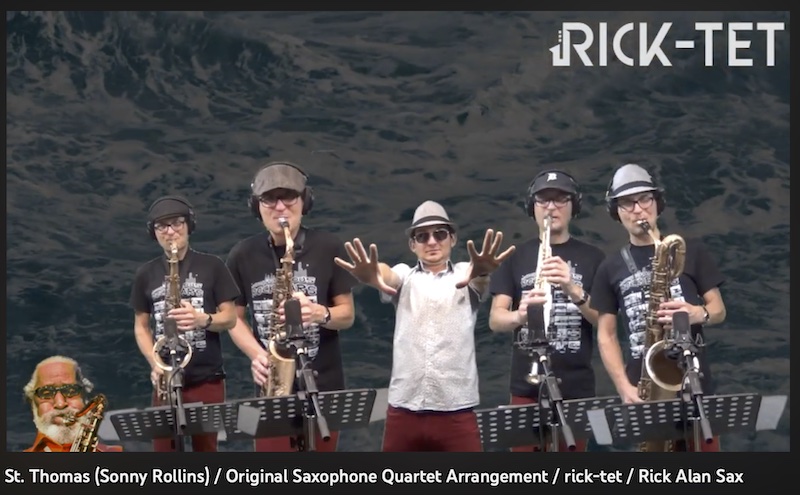
let's take this one step further
Sometimes as an arranger writing for four saxophones I found myself running into a dilemma: while tenor saxophone is (and always be) my native voice, I absolutely adore playing (and listening to) the baritone sax. It was quite difficult for me, however, to feature the baritone sax as I would like in a quartet setting because, in doing so, you lose the all-important bottom note of the chords and, many times, the rhythmic momentum of the group. It was at that time that I decided to do what any obsessive musician with too much time on his hands would do: attempt to sell a couple of smaller saxophones and look for something substantially bigger.When I was in high school I was already keenly aware of the existence of extremely low-voiced saxophones, despite the fact we were still quite a few years away from YouTube making anything and everything available at the press of a button.
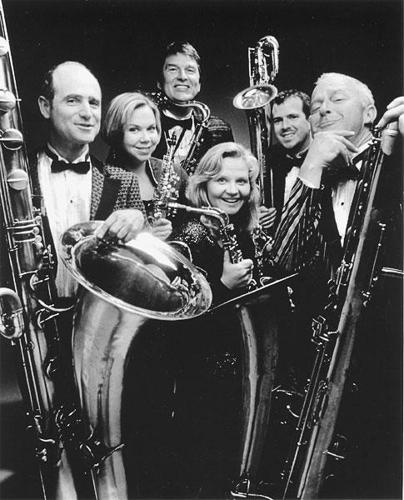
Oh the way it shook the speakers of my first car!
Present day, I knew I couldn't locate LET ALONE AFFORD a super-rare contrabass, so I decided to begin my search for the relatively easier-to-find bass saxophone. I mentioned my bass plan to a friend of mine that I was interested in getting one to add a huge new swatch to my musical palette. Strangely, he almost immediately had a colleague who was sitting on one and seemed more-than-happy to get rid of it.The bass I drove to check out was a giant silver 1920's monster labeled "York Grand Rapids". What a coincidence--it's from my home state in the U.S. and from a city where I spent many years performing almost weekly! I'd like to say it was love-at-first-blow romance but it certainly wasn't. I could barely get any useable sounds out of it with my baritone sax mouthpiece and the bass saxophone mouthpiece it came with wasn't making life easier, either. So I did the smart, responsible adult-thing and left without buying the saxophone.
Just kidding. You know I'm kidding.
As I figured out how to move the antique monstrosity around in it's red gig bag and into my Mazda minivan I truly had no idea the battle I was thrusting myself into.the bass
You see, bass saxophones are similar to other saxophones and all saxophones have little quirks. Some notes need a little 'english' to make them perfectly in tune. Some notes could perhaps speak a little easier. Some notes have a different tonal color than the notes directly above and below them. But it's something all saxophonists get used to dealing with and, honestly, I believe that it is something that adds character and a human element to the sound. The thing I didn't pay enough attention to, however, was that every time a saxophone gets bigger the quirks are also bigger. Therefore, the vintage bass is an atrocity.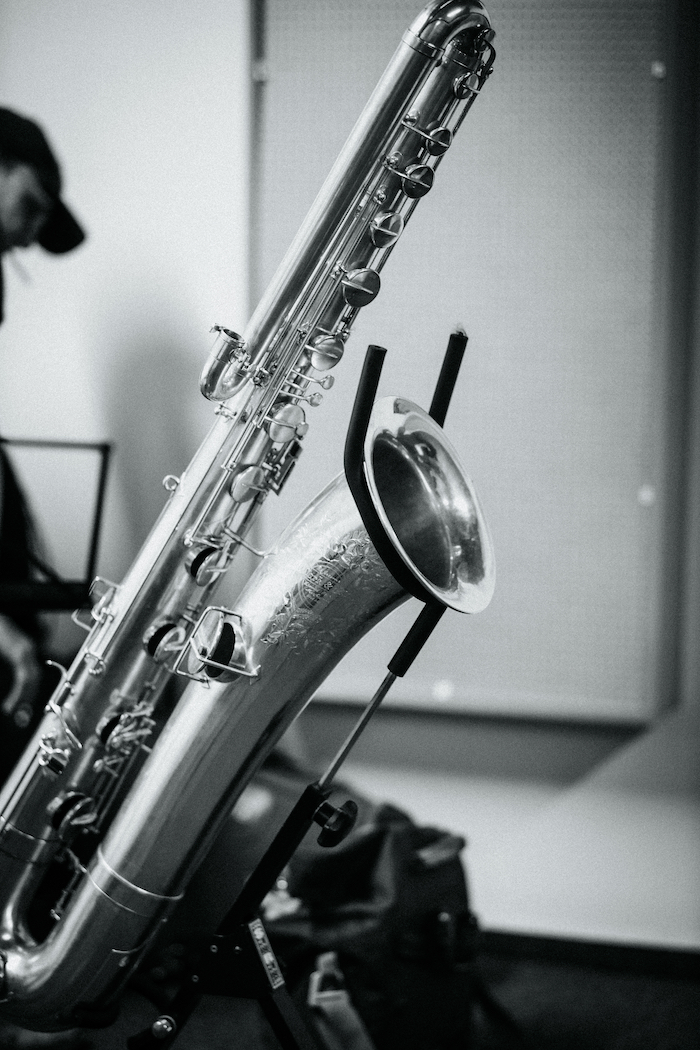 I have standard notes that I cannot play without the help of awkward, uncomfortable alternate fingerings.
 Low Bb is almost a low B, low B is almost Bb.
Middle A is notoriously flat, middle D is brutally stuffy. The horn is keyed from Bb to high Eb, so to achieve the range of a standard saxophone I had to devise altissimo fingerings starting at high E. These are beautiful machines but they are absolutely not perfect machines. And they certainly require way more air than I ever wished to provide.For the next year, all of the time I spent working on flute and improvisation was put on the shelf. I went on a desperate bass mouthpiece hunt, trying anything and everything until I finally settled upon a piece. It was a fine balance of tone, intonation, volume and air quantity. Some mouthpieces had a great tone but no volume, some had plenty of volume but not enough rumbly bass EQ, some would not tune up to save my life and some were just plain garbage. After settling on a mouthpiece, I decided to drop another huge sum of money on the bass and have it (finally) professionally overhauled. Night and day! After eliminating 50-year-old pads and structural leaks it was down to the player to get his chops together: intervals, long tones, and note-taming until my hair started to turn grey. Even with all of that (mostly) behind me the instrument still caused me anxiety to play it in any kind of high-pressure situation. But it WAS finally useable and I began writing for saxophone quintet (s-a-t-b-bs), giddy as a I could ever be.
going live
It was never my intention to turn these arrangements loose onto a live group of musicians (because the arrangements are stupid-difficult and 100% self-serving), however I'd be lying if I said the idea wasn't popping up occasionally in the back of my mind. I live in Germany and Germans seem to have appreciation for something unique, something artsy. There are tons of culture centers around the country that play host to interesting, original projects and it seems that during the summer you're never more than 50 km from the nearest jazz festival. I don't want to say that this project became a personal "hail mary" pass for me, but let's just say it sure would be nice to do something artsy, musical, original and fun for a living once again.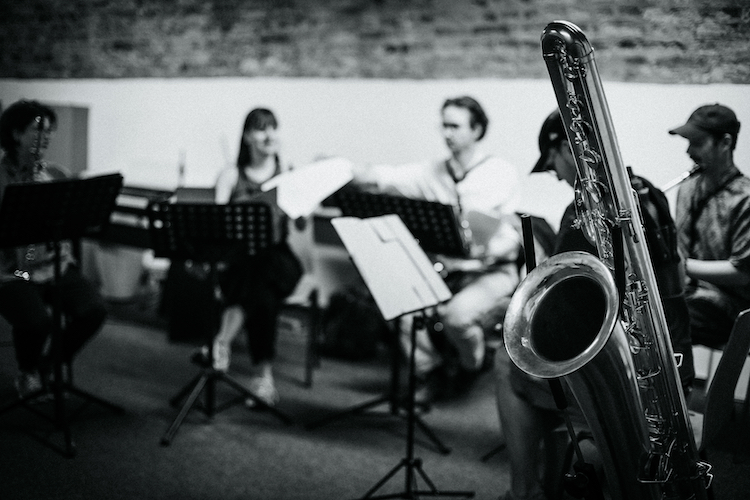 The first thing for me to do was to decide what instrument I was going to play live. I had already recorded all of the parts to all of the arrangements alone in the safety of my rehearsal room and felt relatively confident in any of the chairs. Certainly tenor would be the easiest voice for me to cover and give me a nice chance to utilize my improvisation chops, but there are also so many great tenor saxophonists who absolutely smoke me in Germany and it may, surprisingly, be the easiest chair for me to fill. I used to play soprano in my high school quartet and I really enjoyed being the point-man for the group. I relished the opportunity to explore alto again after so many years in "In a Sentimental Mood", surely this could be a good place for me? Lastly, I as I've said to friends and colleagues before, I believe baritone sax to be the king of the saxophones and truly the most versatile to any sitaution. But really, truly, at the end of the day, I had a realization: I was the guy that owned the bass.
When I came to grips with the fact that it would be the de facto bottom of the group, I told myself I would only feel good about the hassles of bass saxophone if I surround myself with world-class saxophonists in the top-four voices.
Players that would inspire me to play--players that would inspire me to keep writing
, and allow me to continue the exploration of the sound of five different-voiced saxophones kicking-ass together.After an exhaustive search I do believe I've exceeded my goal.
-